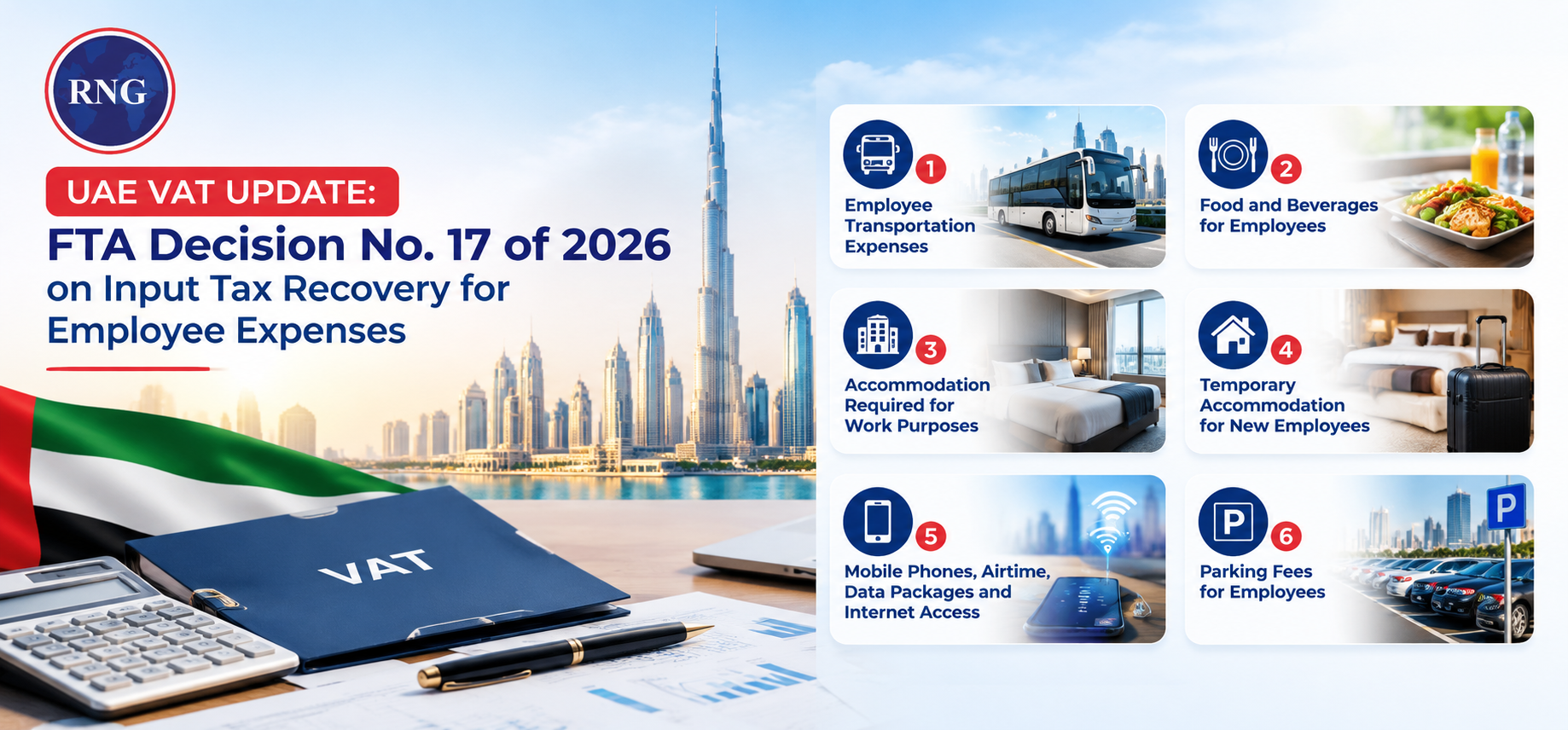
Businesses in the UAE that provide employee transportation, accommodation, food, mobile phones, internet access or parking facilities need to review their VAT recovery practices following the issuance of Federal Tax Authority (FTA) Decision No. 17 of 2026.
Issued on 9 September 2026, the Decision specifies the cases and conditions under which taxable persons may recover or deduct input VAT incurred on certain goods and services provided to employees free of charge.
The Decision came into effect on 1 October 2026 and establishes specific requirements that businesses must satisfy before recovering input VAT on the covered employee expenses.
What Is FTA Decision No. 17 of 2026?
FTA Decision No. 17 of 2026 addresses input VAT recovery on goods and services provided to employees without charge, where the employer has a contractual obligation or documented policy to provide those goods or services.
The Decision sets out six categories of employee expenses for which input VAT recovery may be available, subject to the applicable conditions. These provisions do not establish an automatic right to recover VAT on every employee-related expense. Eligibility depends on the nature of the expense and compliance with the specific conditions.
Six Categories of Employee Expenses Eligible for Input VAT Recovery
1. Employee Transportation Expenses
Input VAT on employee transportation may be recoverable when all the following conditions are met:
Transportation is provided between the employee’s residence and workplace, to clients’ premises, or for other purposes directly related to performing job duties.
The service is not used for the employee’s personal benefit.
The employee cannot choose to receive a cash allowance or other financial compensation instead of the transportation service.
Businesses should review their employee transportation arrangements and retain appropriate supporting documentation.
2. Food and Beverages for Employees
Input VAT on food and beverage expenses may be recoverable where the specified workplace and accommodation-related conditions are met:
The employee’s residence is in a remote, distant or isolated area.
Appropriate food preparation facilities are unavailable at the residence or workplace, as applicable, and nearby restaurants or other facilities are not easily accessible.
The provision of food and beverages is directly linked to the work period or residence period required because of the job.
The employee cannot opt for a cash allowance instead of the food and beverages.
Employers should assess whether their arrangements satisfy all the specified conditions before claiming input VAT.
3. Accommodation Required for Work Purposes
Input VAT incurred on employee accommodation may be recoverable if the accommodation is provided to meet operational requirements and satisfies the conditions in the Decision:
The employee cannot choose a cash allowance or financial compensation instead of accommodation.
The accommodation is linked to operational requirements and is not part of the employee’s benefits or ordinary compensation arrangements.
The nature or requirements of the job necessitate that the employee resides near the workplace, work site or client’s location.
The accommodation is designated exclusively for the relevant employee, subject to the Decision’s exception where an employee is required to reside permanently near the workplace and the accommodation becomes their usual residence.
The accommodation is appropriate to the job requirements and basic residency needs, without significant recreational or personal features beyond its primary work-related purpose.
Businesses providing accommodation to employees should carefully evaluate the purpose, nature and terms of each arrangement.
4. Temporary Accommodation for New Employees
The Decision also addresses the recovery of input VAT for temporary accommodation provided to new employees. To qualify under this category:
The accommodation must be temporary and provided for no longer than 30 days.
The accommodation must be appropriate to the job requirements and basic residency needs.
Employers should maintain records of the accommodation period and its business purpose to support their VAT treatment.
5. Mobile Phones, Airtime, Data Packages and Internet Access
Input VAT recovery may be available for employee mobile phones, airtime, data packages and home internet access provided through a modem or router, subject to the prescribed conditions:
The goods and services must be necessary for employees to perform their job duties, including duties outside normal working hours or away from the workplace, such as remote working and work-related communications.
Their use must be limited to work purposes, or any personal use must be incidental and insignificant rather than the primary purpose.
The employer must maintain a documented internal policy specifying permitted use and the consequences of unauthorised use.
The employer must have reasonable monitoring mechanisms to track usage and verify compliance, while maintaining relevant records and justifications where unauthorised use occurs.
Businesses should review their employee IT and telecommunications policies to ensure that permitted usage, monitoring procedures and recordkeeping requirements are clearly documented.
6. Parking Fees for Employees
Input VAT on parking fees may be recoverable where parking spaces are allocated to employees and all the relevant conditions are met:
Parking fees are incurred solely for business purposes and are directly related to employees’ job duties, business visits or related assignments.
The employer has a documented internal policy governing employee parking reimbursements and the applicable approval process.
Documents proving payment are retained, such as receipts showing the date, time, amount of the fees and tax paid.
Businesses should ensure that parking claims are supported by appropriate evidence and are directly connected to business activities.
What Should UAE Businesses Do Before Claiming Input VAT?
To prepare for the application of FTA Decision No. 17 of 2026, businesses should review their employee expense arrangements and establish appropriate compliance procedures.
Review employee-related expenses: Identify expenditure on transportation, food and beverages, accommodation, telecommunications, internet access and parking.
Verify eligibility for each expense category: Check the specific conditions applicable to each expense. Do not assume that an expense qualifies simply because it is incurred for an employee.
Update internal policies: Where required, establish or revise documented policies covering employee benefits, telecommunications usage, parking reimbursements and approval procedures.
Maintain supporting documentation: Retain relevant invoices, receipts, payment records, accommodation details, internal policies, approvals and other evidence needed to demonstrate compliance.
Review VAT return treatment: Ensure that input VAT claims are assessed against the relevant requirements before being included in VAT returns. Review existing processes where employee expenses have previously been treated differently.
Seek professional VAT advice: Where the business purpose, employee arrangements or supporting evidence is unclear, obtain professional advice before claiming input VAT.

 Businesses in the UAE that provide employee transportation, accommodation, food, mobile phones, internet access or parking facilities need to review their VAT recovery practices following the issuance of Federal Tax Authority (FTA) Decision No. 17 of 2026.